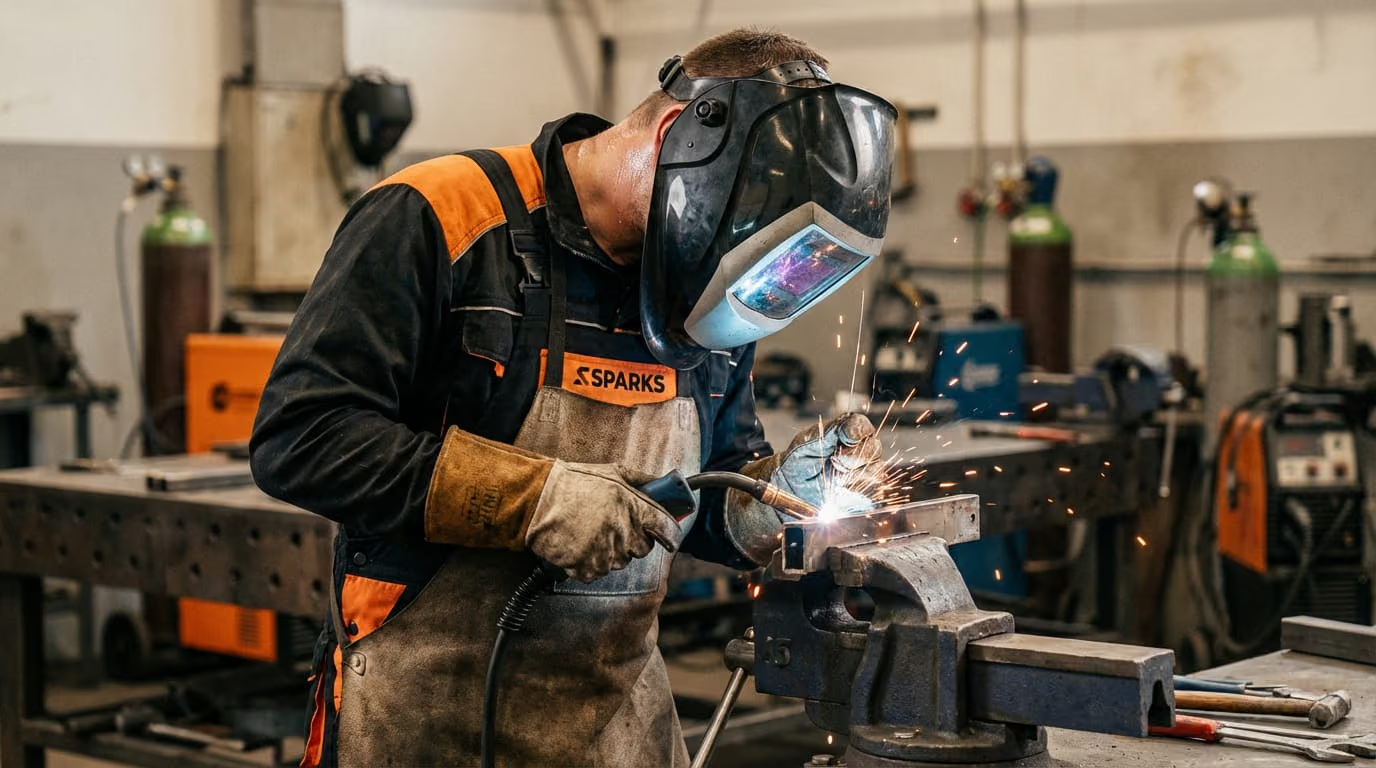
During a refinery turnaround in Tarragona or the launch of a ship in Cartagena, welding is the operation that separates safety from disaster. ISO 9606 is the international standard that qualifies the welder —the individual— to keep that line intact, and it pays to understand it before you let anyone onto your site.
What ISO 9606 actually qualifies (and what it does not)
This is where half the industry's confusion begins. ISO 9606-1 (steels; Part 5 covers titanium) qualifies the welder through a practical test —the WQT, Welder Qualification Test— which verifies their skill for a specific process, position and range of material and thickness. Do not confuse this with two documents that always travel with it:
- WPS (Welding Procedure Specification): how to weld —parameters, gas, filler metal, preheat—. It is the recipe.
- PQR / WPQR (Welding Procedure Qualification Record): the record that qualifies the procedure under EN ISO 15614 (or ASME IX), via destructive testing on a coupon. It qualifies the recipe, never the person.
In practice, a correct ISO 9606 certificate reads, for example, as 141 T BW FM5 6G — TIG process (141), tube (T), butt weld (BW), material group and 6G position. That code tells you exactly what the welder is authorised to weld.
Processes, positions and materials the certificate covers
The qualification is specific, not generic. A welder who excels with covered electrode may not be qualified in orbital TIG. Typical ranges on Spanish industrial sites:
- Processes: 111 (covered electrode), 135/136 (MAG solid wire / gas-shielded flux-cored), 141 (TIG), 114 (self-shielded flux-cored).
- Positions: from 1G (flat, rotating the pipe) to 6G —fixed pipe at 45°, the benchmark test for pressure piping—. Passing 6G covers the lower positions by extension.
- Materials: carbon steel, austenitic stainless 316L, duplex 2205 (common in seawater and petrochemical service), nickel alloys.
Plate and pipework in duplex 2205, for instance, demands tight heat-input control to preserve the ferrite-austenite balance: both the welder's qualification and the WPS must cover that range.
ISO 9606 within the quality system
The standard does not stand alone. Across the European Union it is applied alongside EN ISO 15614 (procedure qualification —the WPQR we mentioned) and EN ISO 3834, which sets the welding quality requirements of the fabricating company itself —3834-2 for comprehensive requirements—. If your project falls under CE marking of structures (EN 1090), these three documents form the backbone of the file. Oversight typically falls to a welding coordinator (IWE/IWT) and an NDT inspector. You can read more about how we structure all of this on our quality and certifications page.
How to verify a certificate before anyone climbs the scaffold
Being shown a piece of paper is not enough. A valid ISO 9606 certificate must state: welder identification, an accredited certifying body (in Spain, under ENAC), the process/position/material/thickness range, and validity. Typical validity is 3 years, conditional on a signature revalidation every 6 months by the welding coordinator. Be wary of documents with no verifiable certificate number or body reference. On site, the welding inspector —qualified to ISO 9712 level 2 for the applicable NDT method— will ask for that certificate before signing off the first bead.
What an unqualified welder really costs you
The apparent saving evaporates at the first inspection. If a lot is welded by unqualified personnel, the owner or insurer can reject it, and then come the expanded non-destructive tests (RT radiography, UT ultrasonics), joint cut-outs and rework. During a turnaround, every hour a line stays down can cost far more than the crew itself. As a market reference: a 6G-qualified pipe welder is typically invoiced in the region of €38-55/h depending on process, material and mobilisation; the cost of re-doing a radiographed joint and re-testing it exceeds that comfortably. Certification is not an expense —it is the policy that prevents the big one.
How Sparks Service handles a turnaround
For work of this kind —from a turnaround in the Tarragona chemical hub to boilermaking reinforcement on the Cantabrian coast— we deploy teams of welders and certified pipefitters with documentation validated before anyone reaches site: current ISO 9606 certificates, applicable WPS and supporting WPQR delivered as a traceable dossier. Sparks Service works to 48-hour mobilisation windows, decisive when a rejected joint forces you to reschedule. If you operate in the area, see our coverage in Tarragona or request a quote for your next turnaround.
Preguntas frecuentes
Does the WPQR qualify the welder? No. The WPQR (or PQR) qualifies the welding procedure under EN ISO 15614. The welder is qualified by their ISO 9606 certificate through the WQT. They are distinct, complementary documents.
How long does an ISO 9606 qualification last? Usually 3 years, provided the signature revalidation is maintained every 6 months by the welding coordinator and the welder keeps working within the qualified range without prolonged interruption.
Does a 6G certificate cover the other positions? Yes. By the standard's extension principle, passing 6G (fixed inclined pipe) covers the less demanding positions in that process and material group, but always confirm it on the certificate itself.

